
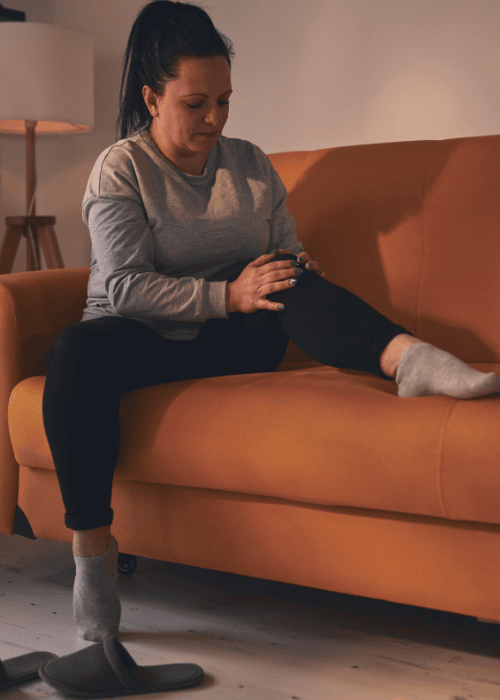
Tingling and numbness, sometimes called “pins and needles,” is a lesser-known symptom of stress and anxiety. Often felt in the hands or feet, tingling or numbness can occur during a panic attack, but also during chronic periods of stress. However, paresthesia could also be caused by physical health conditions, so it’s important to check with your primary healthcare provider.
If you suspect that the physical signs of anxiety are causing paresthesia, a mental health professional can provide support and guidance. This page can also help you better understand tingling anxiety symptoms by exploring:
- What paresthesia is and its common causes
- How mental stress and physical strain can impact nerves and cause paresthesia
- The differences between stress, anxiety, and panic
- How CBT, somatic therapy, and trauma-focused therapy can help people with stress and anxiety
- Where to find professional support and anxiety disorder treatment
What Is Paresthesia?
Paresthesia is the official name for tingling and numbness, sometimes known as “pins and needles.” It’s usually felt in the fingers, hands, arms, feet, or legs, although it can technically occur anywhere in the body.[1]
Common instances of paresthesia include when you hit your “funny bone” (the ulnar nerve in your elbow) or when one of your limbs “falls asleep” after being still for a long time. It occurs when a nerve is irritated or under pressure, causing this nerve to send unnecessary signals to the brain.
This article will explore parasthesia in the context of physical signs of anxiety and stress, although it can be a sign of something else. If you’re experiencing paresthesia frequently, it’s worth visiting your primary healthcare provider. They can check for nerve damage, multiple sclerosis, or diabetic neuropathy, which paresthesia sometimes signifies.[1]
Causes of Paresthesia
Aside from more serious nerve damage, paresthesia can occur in everyday life from surprisingly common situations. For example, temporary numbness or tingling may be caused by:[2]
- Obdormition: This is when numbness or tingling is caused by prolonged pressure on a nerve, such as when your legs have been crossed for a long time.
- Whiplash: Tingling in the upper body may be connected to whiplash (a type of neck injury), and typically goes away within 6 months after the injury occurred.
- Dehydration: Moderate dehydration (a loss of around 5-6% of your total body water) can cause paresthesia.
Aside from these issues, tingling can be caused by pressure, anxiety, and stress. We explore these contributors in the following sections.
Physical Strain or Pressure
When a nerve is squeezed, our arteries can’t send blood to it as usual. This interferes with the nerve’s ability to send signals to the brain, causing limbs to “fall asleep.” People who use wheelchairs or sit for long periods of time are more likely to experience this sensation.[1]
After someone’s limb “falls asleep,” they may feel tingling as the limb “wakes up” again. This is because, as the nerves regain their function, the nervous system becomes hyperactive. Nerves may be irritable for a short period as they recover, but in general, “pins and needles” is a sign that they’re switching back on.[1]
If you’re experiencing tingling in your palm and your fourth or fifth fingers, it could be a sign of ulnar nerve entrapment. This can occur when your elbow has been kept fully bent or has experienced direct pressure for a long period.[3] If mild, this kind of physical strain can be reversed with certain physiotherapy techniques. For example, holding the affected arm straight out to your side and flexing your hand towards you.
It’s worth looking further into specific strains like this; for instance, carpal tunnel and radial tunnel are other possible physical explanations for paresthesia.
Stress and Panic
Stress, anxiety, and panic are other common causes of paresthesic symptoms. Sometimes, this symptom can arise due to panic attacks or hyperventilation (breathing too quickly). Hyperventilation can cause numbness and tingling within just three minutes, so those who experience panic attacks can encounter paresthesia in the mouth, hands, and feet during and after attacks.[2]
Stress, anxiety, and panic can result in paresthesia because of how the body’s stress response functions. For instance, tingling or numbness may occur because the fight-or-flight response diverts blood towards our vital organs and away from our extremities.[4]
Furthermore, breathing too quickly can alter levels of oxygen, carbon dioxide, calcium, and potassium in the blood, which directly causes tingling in the face, hands, and feet.[5]
Defining Stress, Anxiety, and Panic
You may be experiencing stress, anxiety, or panic if (alongside paresthesia) you also have other physical symptoms. Common symptoms include heart palpitations, shakiness, muscle tension, and nausea. Some people also get headaches, chronic fatigue, loss of appetite, dizziness, a feeling like something is stuck in their throat (globus), and teeth grinding.[6]
These conditions are often confused with each other, perhaps because their physical symptoms can overlap. Here’s what each of them means:[7]
- Stress: Often caused by an external trigger, stress can be long-term or short-term. Triggers can include deadlines, interpersonal conflict, illness, or discrimination, among others.
- Anxiety: This occurs even when there isn’t an external stressor. People may have persistent excessive worries or physical symptoms without an identifiable stressor (known as generalized anxiety disorder). Although those with social anxiety or phobias typically have an identifiable trigger, their fear response is disproportionate to the actual level of danger.
- Panic: Panic disorder is a type of anxiety disorder marked by panic attacks. These are intense physical experiences involving fear, fast breathing, dizziness, sweating, and a fast heart rate.
Despite these distinct definitions, stress, anxiety, and panic share the element of nervous system overactivation. In each of these experiences, the nervous system is responding disproportionately to a perceived threat, whether it’s low-level and chronic or acute.
Understanding the source of your paresthesia can be extremely helpful in determining what kind of support and treatment you may need.
Treatment Options for Stress and Anxiety
You may get some immediate relief from paresthesia by moving around. For example, by going for a run or doing some star jumps. You could also try gradually tensing and relaxing each muscle in your body (known as progressive muscle relaxation) or grounding techniques for panic attacks.
However, therapy is often helpful for getting to the root of what you’re anxious or stressed about. There are many therapeutic options for people struggling with stress and anxiety, each with its own unique approach to treatment. Here are some common options that you may encounter:
Cognitive-Behavioral Therapy (CBT) Interventions
CBT is a common treatment for panic and anxiety disorders. If you seek help for panic disorder or physical anxiety symptoms, you’ll likely come across grounding techniques and psychoeducation, which are key elements of the CBT approach.
CBT practitioners may teach you breathing techniques to calm your body’s stress response and help you cultivate mindful awareness of anxiety-provoking thoughts. CBT values challenging these thoughts and reframing them to reduce anxiety.[4]
Practitioners are also likely to enquire about behaviors in your personal, work, and social life that contribute to feelings of stress and anxiety. They will also help you identify ways of managing any problematic actions.[4]
Somatic Therapies
Somatic therapies are an interesting area of psychotherapy that brings together the mind and body. People whose stress and anxiety manifest as physical symptoms may find this treatment option particularly appealing, as it can help overall well-being by addressing both mental and physical symptoms.
Somatic therapy is also sometimes known as “mind-body connection therapy” due to how it incorporates both psychotherapy and mind-body techniques. It sits alongside other forms of somatic therapies, which include things like yoga, tai chi, and mindfulness-based CBT, though it’s a distinct approach in itself.
Somatic therapy can help people with stress, anxiety, depression, grief, chronic pain, digestive disorders, addiction, and trauma. Techniques will vary between practitioners, but in general, it combines talk therapy with physical activities such as dance, yoga, vocal work, massage, and meditation.[8]
This approach typically aims to:[8]
- Teach you to self-regulate and bring yourself out of the fight-or-flight response
- Develop an ability to identify emotions as they arise
- Release and express pent-up emotions
- Increase your body awareness
- Teach you to develop a “home base” within your body
Treatment for Trauma
Physical symptoms of anxiety are common in people with post-traumatic stress disorder (PTSD) or those who have experienced trauma in their past. Alongside re-experiencing their trauma (sometimes called “flashbacks”), wishing to avoid reminders, and experiencing depression, people with PTSD may have heart palpitations, jumpiness, and sweating.[9]
These panic symptoms could be accompanied by paresthesia, as we discussed earlier. For those with trauma, psychotherapy is proven to be an effective option; studies find that it’s better than medication alone as it provides more long-lasting benefits.9
Trauma-informed psychotherapy, like CBT, may provide coping strategies for panic attacks, but they’ll also use talking therapy techniques. Therapists will provide a safe and relaxed space in which you can discuss your past experiences in ways that feel most comfortable for you. You don’t have to talk through every detail if you don’t want to.
You may also be offered EMDR, which stands for eye movement desensitization and reprocessing. This kind of therapy invites people to talk through painful memories while guiding them through certain eye movement exercises. Theoretically, this reduces the emotional heaviness attached to the memories by reprocessing how they’re stored in the brain.
Mission Connection: Get Stress Support Today
Stress and anxiety can manifest in unexpected ways, causing surprising symptoms like paresthesia and dizziness. If you’re not totally sure what your symptoms may mean, take a self-test to learn more about them.
If you would like to begin getting mental health support right away with us here at Mission Connection, you can browse our facilities or our many treatment options. We offer the approaches mentioned in this article (cognitive-behavioral therapy, somatic therapy, trauma-focused therapy, and EMDR) alongside many other therapy types.
If you’re ready to learn ways to manage the emotional and physical symptoms of stress and anxiety, contact our team today.
References
- University of Rochester Medical Center (2024). Understanding the “pins and needles” feeling. University of Rochester Medical Center. https://www.urmc.rochester.edu/encyclopedia/content?ContentTypeID=1&ContentID=58
- Sharif-Alhoseini, M., Rahimi-Movaghar, V., & Vaccaro, A. R. (2012). Underlying causes of paresthesia. Paresthesia, L. E. Imbelloni, Ed., InTech, 71–90. https://doi.org/10.5772/32360
- Johns Hopkins Medicine (n.d.). Ulnar nerve entrapment. Johns Hopkins Medicine. https://www.hopkinsmedicine.org/health/conditions-and-diseases/ulnar-nerve-entrapment
- Simply Psychology (n.d.). A guide to panic attacks and panic disorder. Simply Psychology. https://www.simplypsychology.org/panic-disorder.html
- Thomas, L. (2022). Pins and needles and anxiety. News-Medical. https://www.news-medical.net/health/Pins-and-Needles-and-Anxiety.aspx
- Psychology Today (2021). Are your physical symptoms triggered by emotions? Psychology Today. https://www.psychologytoday.com/us/blog/understanding-hypnosis/202111/are-your-physical-symptoms-triggered-by-emotions
- American Psychological Association (2022). What’s the difference between stress and anxiety? American Psychological Association. https://www.apa.org/topics/stress/anxiety-difference
- Psychology Today (2022). Somatic therapy. Psychology Today. https://www.psychologytoday.com/us/therapy-types/somatic-therapy
- Stern, A. P. (2019). Psychotherapy leads in treating post-traumatic stress disorder. Harvard Health Publishing. https://www.health.harvard.edu/blog/psychotherapy-leads-in-treating-post-traumatic-stress-disorder-2019091217611