
What the ACEs Checklist Measures
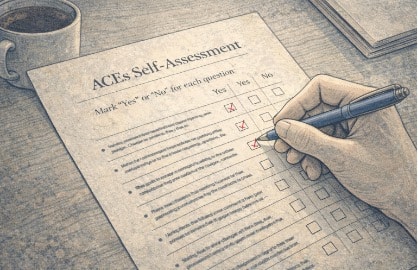
The ACEs checklist is a 10-question self-assessment that scores your exposure to childhood abuse, neglect, and household dysfunction before age 18, with one point for each “yes.” A score of 4 or higher is the threshold most often linked in research to higher rates of adult anxiety, depression, and PTSD. Knowing where you land gives you a concrete starting point for deciding what kind of support, if any, would actually help. The sections below walk through all 10 items, what your score means, and what you can do with that information.
The 10 ACEs Checklist for Adults
The original checklist covers 10 categories of adverse childhood experiences, grouped into three areas: abuse, neglect, and household dysfunction. For each item below, consider whether this applied to your life before your 18th birthday.
Abuse
1. Physical Abuse Did an adult in your home often push, grab, slap, or hit you hard enough to leave marks or cause physical injury?
2. Emotional Abuse Did an adult in your home often insult you, swear at you, humiliate you, or make you feel threatened or afraid?
3. Sexual Abuse Did an adult or someone at least 5 years older than you ever touch you sexually or attempt to do so?
Neglect
4. Physical Neglect Did you often go without enough food, clean clothing, or a safe place to live? Did you feel that no adult was consistently looking out for your basic needs?
5. Emotional Neglect Did you often feel that no one in your family loved you, valued you, or thought you were important? Was affection or emotional support rarely present in your home?
Household Dysfunction
6. Domestic Violence Did you witness a parent or stepparent being physically hurt by their partner on a regular basis?
7. Household Substance Use Did a household member have a problem with alcohol or drugs that affected the safety or stability of your home environment?
8. Household Mental Illness Was a household member depressed, mentally ill, or did a family member attempt suicide during your childhood?
9. Parental Separation or Divorce Were your parents ever separated or divorced while you were growing up?
10. Incarcerated Household Member Did any household member go to prison during your childhood?
Calculating Your ACE Score
Each “yes” answer counts as one point, regardless of how often the experience happened. Add up your total. Your score will fall between 0 and 10. That number is your ACE score.
What Your ACE Score Means
A score of 0 means none of the 10 categories applied to your childhood. Scores between 1 and 3 indicate some exposure to adversity, which can still have an impact depending on the nature of the experience and the support available at the time.
A score of 4 or higher is generally associated with a greater likelihood of mental health challenges in adulthood, including anxiety, depression, and PTSD. The higher the score, the more categories of adversity you were exposed to, and the more layers there may be to work through in recovery.
A high score is not a sentence. Many adults with high ACE scores go on to build healthy, fulfilling lives, particularly when they have access to the right support. Your score is a starting point for understanding, not a ceiling on what healing can look like for you.
How Childhood Trauma Shows Up in Adulthood
The effects of ACEs do not always present in obvious ways. For many adults, the signs appear in patterns and symptoms that feel disconnected from anything in their past.
Persistent anxiety, depression, chronic low self-worth, and difficulty trusting others are common. Some adults describe feeling emotionally numb or cut off from their own feelings, which is often a trauma response known as dissociation. Others experience sleep difficulties, unexplained physical pain, or chronic fatigue without a clear medical cause.
Relationship and Behavioral Patterns
Adults with higher ACE scores often struggle in relationships, not because something is fundamentally wrong with them, but because early experiences shaped how they learned to connect with others. Difficulty setting boundaries, fear of abandonment, and repeating painful relationship cycles are all common patterns rooted in childhood trauma responses.
These are learned survival behaviors that can change. Therapy helps you trace those patterns back to where they began and gives you the tools to build different ones.
Healing from ACEs: Therapy Options That Work

Many adults find that trauma-focused therapy is highly effective for addressing the long-term effects of childhood ACEs. Medication is not always required, and several evidence-based approaches target trauma directly and produce meaningful results on their own.
Cognitive Behavioral Therapy (CBT)
CBT helps identify and shift the thought patterns that formed in response to childhood trauma. If you grew up believing you were unsafe, unlovable, or responsible for what happened to you, CBT works to replace those core beliefs with more accurate, grounded ones. It is one of the most widely used approaches in trauma care and tends to work well for adults processing specific beliefs or behaviors tied to their ACE history.
EMDR (Eye Movement Desensitization and Reprocessing)
EMDR helps the brain reprocess traumatic memories so they no longer carry the same emotional charge. A key advantage is that it does not require you to narrate the trauma in detail to work, which makes it accessible for people who find verbal processing difficult or re-traumatizing.
DBT (Dialectical Behavior Therapy)
DBT focuses on building practical skills in emotional regulation, distress tolerance, and interpersonal effectiveness. For adults whose childhood trauma left them with overwhelming emotions or unstable relationships, DBT provides concrete, day-to-day tools that extend beyond the therapy room.
Group Therapy and Trauma-Focused Approaches
Group therapy allows adults to process their experiences in a supported community setting. Sharing with others who understand can reduce isolation and is often a powerful complement to individual work, particularly for adults who grew up feeling alone in their experiences.
A Note on Self-Directed Healing
Some people choose to work through the effects of childhood trauma independently, through journaling, mindfulness practices, or self-help resources. This approach offers flexibility and lower cost, and for mild or isolated experiences, it can provide genuine relief. The limitation is that without a trained professional, it becomes harder to stay grounded when difficult memories surface.
Self-directed approaches also tend to fall short for complex or layered trauma, where patterns are deeply ingrained and need more than awareness to shift. Outpatient therapy offers a structured middle ground: professional, evidence-based support that fits into everyday life without requiring a residential program or significant time away from your responsibilities.
Turning Your ACE Score Into a Path Forward With Mission Connection

An ACE score is a prompt, not a verdict. Self-directed tools like journaling and mindfulness can help with milder experiences, while trauma-focused therapy tends to be the stronger option for adults carrying layered or long-standing effects of childhood adversity.
Mission Connection offers outpatient trauma therapy built around evidence-based approaches like CBT, EMDR, and DBT, delivered in person or via telehealth across California, Washington, and Virginia. If your score or your symptoms suggest it is time for structured support, reach out to start trauma therapy with Mission Connection.
Frequently Asked Questions (FAQs)
Can adults complete the ACEs checklist if they have limited memories of childhood?
Yes. Some childhood experiences are held as emotional or physical responses rather than clear, narrative memories. You can still go through the checklist based on your general sense of what your home life was like. A therapist can help you make sense of gaps and work through whatever memories you do carry.
Does a high ACE score mean you will develop a mental health condition?
No. A high ACE score reflects exposure to adversity, but many factors shape long-term outcomes, including the support you had growing up and the resources available to you now. The score is a tool for reflection and awareness, not a fixed prediction of your mental health.
Can therapy help with trauma that happened decades ago?
Yes. The emotional impact of childhood trauma can persist well into adulthood, but trauma-focused therapies like EMDR and CBT are effective regardless of how much time has passed. Many adults begin meaningful recovery work in their 30s, 40s, 50s, and beyond.
Do you have to talk about traumatic memories in detail to heal?
No. Approaches like EMDR work without requiring you to narrate the details of what happened. Your therapist will work with you to identify an approach that feels safe and appropriate for where you are in your process, and that can evolve over time.
How does Mission Connection approach trauma care for adults with high ACE scores?
Mission Connection provides outpatient trauma-focused care designed for adults dealing with the lasting effects of childhood adversity. Our programs include individual therapy, group sessions, and evidence-based modalities such as CBT, EMDR, and DBT, with psychiatric support available when needed. We serve clients across California, Washington, and Virginia through flexible in-person and telehealth options, making consistent, professional trauma support accessible around your schedule.